The Woodcutter’s Wife Adopts the Baby Sent from the Train
The Most Precious of CargoesThe Woodcutter’s Wife Adopts the Baby Sent from the Train is the turning point in which the Poor Woodcutter’s Wife’s longing for a child becomes an act of care with immediate physical and moral costs. When Convoy 49 answers her outstretched appeal by dropping a bundled infant into the snow, she does not receive the serene, sacred image she has imagined: she receives a starving, furious baby who must be kept alive. Her decision to take the child as her own sets her against the Poor Woodcutter’s rejection and commits her to the daily work of feeding and protecting a daughter who cannot survive without help.
The Train’s Delivery
The Poor Woodcutter’s Wife has been waiting beside the railway, waving and calling for the train to wait. Convoy 49 seems, at last, to answer. A hand appears at a narrow window, brandishes a flag, and drops a package onto the snow some twenty paces from her. The gesture is more than a scrap of paper or an unanswered plea: the hand points for her to pick up the bundle, as if the cargo has been intended for her alone. She abandons her small bundle of winter twigs, runs to it, and unties its knots with the feverish attention of someone opening a mysterious gift.
What she finds both fulfills and overturns her expectation. The infant does not smile or reach out like a baby in a sacred image. She struggles, screams, clenches her fists, and thrashes with hunger. The Poor Woodcutter’s Wife wraps her in her many scarves and presses her against her chest, but the child’s mouth cannot find milk there. In the same moment, the woman feels herself become a mother and realizes that love does not provide what the child physically needs. Her happiness is therefore inseparable from alarm: she has been given the child she longed for, but no means to feed her.
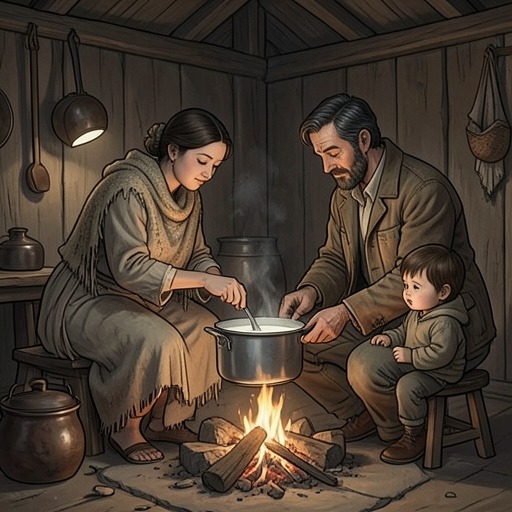
The bundle itself becomes a recurring name and image for the infant. The Poor Woodcutter’s Wife calls her little cargo and little package, yet the words do not diminish the baby’s distress: the package protests, cries, and insists on being fed. At the cabin, the woman lights the fire, boils water, and searches for something the infant can take. She tries a finger, then buckwheat porridge made with kasha; the baby sucks, discovers the deception, and cries again. The woman offers cooking water and small tastes of porridge until thirst is eased and hunger is partly quieted. Her first care is neither effortless nor idealized. It is improvised, repeated labor in response to a child whose need cannot wait.
A Claim Against Rejection
When the Poor Woodcutter returns from his public works, the baby’s crying provokes his anger. The Poor Woodcutter’s Wife names the child plainly as a child and then, when he reacts with disgust and racial contempt, declares that the infant is her own little angel and could be his too if he chose. He refuses that invitation. He calls the baby the offspring of an accursed race and treats her as something to be discarded, while his wife understands the arrival as a gift entrusted to her.
The conflict sharpens when the Poor Woodcutter wraps the baby and strides toward the door, intending to leave her beside the railway. The Poor Woodcutter’s Wife tries to snatch the infant back and then blocks his way. She makes clear that abandoning the child would mean throwing her out with the baby under the wheels of the cargo train, and warns that the gods would pursue and curse him. Her appeal makes the choice consequential for both of them: this is no longer only a dispute about an unwanted infant, but a test of whether their marriage can accommodate the life she has decided to protect.
The Poor Woodcutter pauses and returns the child. In the hand-to-hand struggle, the infant’s sex is revealed: the child previously treated as a little lad is a girl. The Poor Woodcutter’s Wife embraces her and declares that the girl will be a joy to both of them. He rejects that shared future and says he does not want to hear or see her. Yet his anger does not erase every trace of practical concern. When his wife takes the baby to the woodshed, he follows and tosses her a tattered bearskin, gnawed by field mice, warning her not to catch a cold. She answers that the gods will protect her. The offer is meager, but it marks the complicated distance between his refusal to accept the child and his awareness of the cold his wife will face.
Firewood for Milk
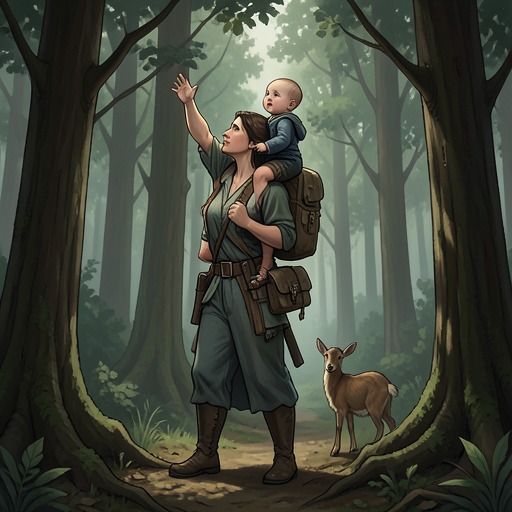
The Poor Woodcutter’s Wife soon recognizes that the child cannot live on cooking water and porridge alone. She knows the infant needs milk, and carries her, wrapped in scarves and in the precious shawl from the train, into a dense, secluded grove where the Poor Woodcutter’s Wife believes the strange forest world begins. There she seeks the solitary Man with the Goat and Shattered Face, whom she has glimpsed near the grove and whose goat may still be producing milk. Her journey is an extension of the adoption: taking the baby in has made her responsible for finding resources beyond the cabin and beyond her own body.
When the Man with the Goat and Shattered Face asks what she can offer for the milk, she answers that she will give everything she has, then admits that she has nothing. She proposes a continuing exchange instead: every day the gods give her, in winter and summer, she will bring a bundle of firewood for two mouthfuls of milk. He points out that the wood is not his, and the proposal proceeds without disguising its hardship. The bargain makes care materially visible: the infant’s survival will depend on the woman’s repeated labor and on another person’s willingness to provide what she cannot.
The Man with the Goat and Shattered Face examines the baby and explains that she needs milk; because he has no jenny’s milk, his goat’s milk must be diluted with boiled water for the next three months. He also advises supplementing it with porridge and, in spring, fruits and vegetables. The Poor Woodcutter’s Wife receives her daughter lovingly, falls to her knees, and tries to kiss his hand. He recoils and tells her to get up, refusing both the posture of submission and public gratitude. He also insists that she never tell anyone he has a goat or gives away milk. The help is real, but it must remain concealed.
The arrangement becomes a daily practice: each morning the Poor Woodcutter’s Wife brings a bundle of firewood and receives a warm cupful of milk. The child endures and survives, though she is never fully satisfied; hunger continues to gnaw at her, and, once restored to health, she howls without restraint. The exchange saves the girl without making deprivation vanish. Its consequence is a fragile form of security maintained through repeated work, quiet generosity, and a supply of milk that remains limited.
From Gift to Ongoing Care
The shawl that wrapped the infant links the train’s delivery to the family’s later survival. The Poor Woodcutter’s Wife first sees its fine woven threads, knotted fringe, and gold and silver embroidery as a rich covering for the gift she believes the gods have sent. She sleeps with her precious cargo clasped in her arms, the baby wrapped in that shawl. Later, the shawl also serves as a practical container: after the Man with the Goat and Shattered Face dies, she wraps in it the old clothes, freshly made cheese, and tools for making cheese that she carries away.
The adoption therefore extends beyond the moment the infant is lifted from the snow. After discovering the Man with the Goat and Shattered Face’s body, the Poor Woodcutter’s Wife covers him with blossoming branches and gives thanks for the hand that dropped the baby and for the righteousness of the man who helped her raise her. She no longer trusts the gods of the train as she once did; her understanding of the child’s survival has shifted toward the concrete acts of human assistance that made it possible. Taking her daughter by the hand and leading the goat, she walks east with the shawl-wrapped supplies. In a ruined village, she settles among the remains, spreads the shawl over a surviving section of wall, lays out the cheeses, and waits for customers with her daughter on her lap and the little goat grazing nearby. The initial act of adoption has become an enduring responsibility: the child is not merely the train’s precious cargo, but the daughter for whom her mother keeps finding a way to provide.